From zero to production in 3 days, with one person and a factory of agents.
SERENA is corporate wellbeing you can measure. We built it with the Horme factory and publish its numbers as they are, including the ones that aren't good yet.
days from baseline to production
products: site, Studio and Studio Admin
person decides; agents execute
change failure today · goal ≤ 20%
What this case proves, and what it doesn’t yet.
SERENA went through the factory cycle all the way to production. The second decision, the outcome review, not yet: we cross it at the November 18 pilot and will publish what comes out.
- 01ListenDoneCustomer, market and tech debt in one backlog.
- 02PrioritizeDoneRanked by value; nothing enters without sign-off.
- 03PricePartialWeeks and scope, yes. Money cost per delivery, not yet.
- AInvestment decisionDonePilot scope approved on Nov 4.
- 04SpecifyDone23 one-page specs.
- 05Build through 5 reviewsDone27 production releases in 3 days.
- 06Prove the outcomePendingMeasured at the Nov 18 pilot.
- BOutcome reviewPendingContinue, adjust or stop, with the outcome in hand.
- That the factory delivers: from base to production in 3 days, with 5 reviews and a rollback plan on every release.
- That the evidence builds itself: metrics come straight from the repository and the log.
- That one person can run it: 17 merges for every human decision.
- Business return: SERENA has no paying customers yet; the first outcome arrives on Nov 18.
- Cost per delivery: we’re measuring it and will publish it before we charge that way.
- A third-party relationship: SERENA is our own product, so we are both the client and the factory.
A pilot with a fixed date and no team.
A corporate event in Monterrey on November 18, with partial client information and no access to their data. It needed a bilingual site, a PWA for participants and a panel to lead the live session, private by design: only averages of 5 or more people.
Everything configurable: nothing about the client lives in the code.
Every requirement follows the same path. No shortcuts.
A requirement is a one-page spec with its user story and success criteria. Approved spec (G0) Man in the loop → tests first (G1) → quality, architecture, UX, accessibility, privacy and security (G2) → main → guardian agent → staging → human approval (G4) Man in the loop → production with rollback.
-
3 nov
Baseline and decisions
Single source, 10 ADRs and contracts. A person approves; agents propose.
Man in the loop
-
4 nov
Specs and trains
Every requirement starts with its one-page spec (23 in total). 18 staging deploys on day one.
-
5 nov
Continuous integration
37 merges to main in one day; version 0.6.0 on staging.
-
6 nov
First production
Guardian agent review and human approval (G4).
Man in the loop
15 production deploys, each with a rollback plan.
-
7–8 nov
Harden and measure
Change failure from 40% to 25%. 23 lessons in the book; 3 already adopted. Adopting the rest is part of the stability goal.
-
18 nov
Live pilot
Corporate event in Monterrey: QR, mood check-in and anonymous survey. This is where the outcome review happens: the outcome against what was expected.
Elite speed. Stability to improve. We say it with numbers.
| Metric | SERENA | DORA benchmark | Level | Goal |
|---|---|---|---|---|
| Deployment frequency | 12.2 / day to staging 27 to production in 3 days | Elite: on demand | Elite | Keep |
| Lead time for changes | 0.45 h median, change → main 15.5 h idea → main | Elite: < 1 day | Elite | < 24 h idea → production |
| Change failure rate | 25% down from 40% on Nov 6 | Elite 5% · High 20% · Low 40% | Between high and low | ≤ 20% by Feb 3 ≤ 10% after |
| Time to restore | No incidents recorded | Elite: < 1 h | Not yet measurable | < 1 h, with error monitoring on |
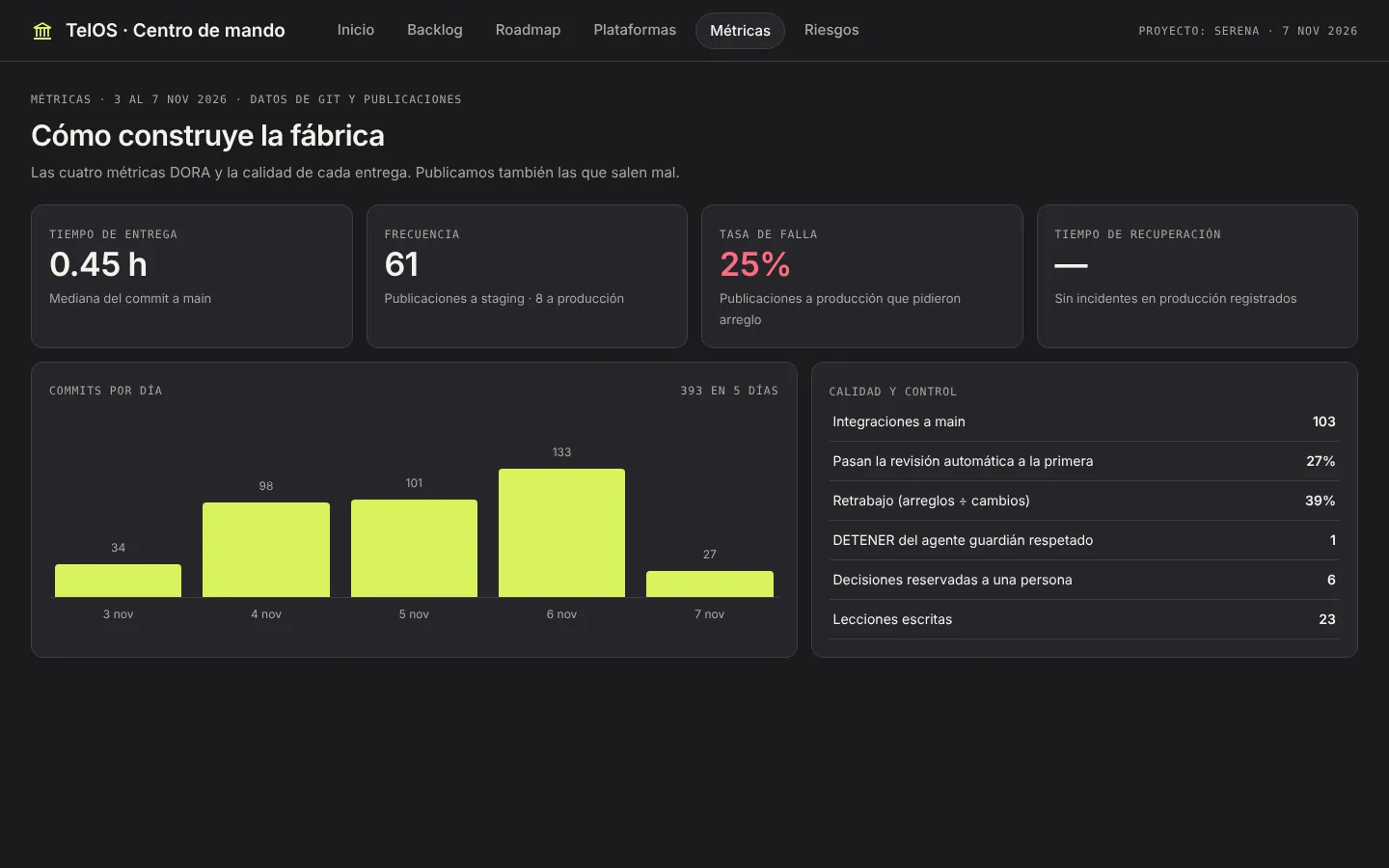
Method: change failure = hotfix merges ÷ production deployments. No incidents recorded doesn't mean zero failures: production error monitoring is deferred by an architecture decision, so that metric isn't measurable yet. Baseline: Nov 3–7, 2026, 5 active days. Benchmarks: DORA 2024 and 2025. Source
merges to main per day
merges per human decision
rework · goal ≤ 20%
pass the automated review (G2) first time · goal ≥ 60%
On speed, the factory is already in DORA's elite group: it merges changes in minutes and ships on demand. On stability, a 25% change failure rate puts it behind the high group (20%), the same pattern DORA 2025 describes: AI raises throughput and instability alike. So the next investment isn't more speed, it's gates that block before main.
One person can run this because everything shows on four boards.
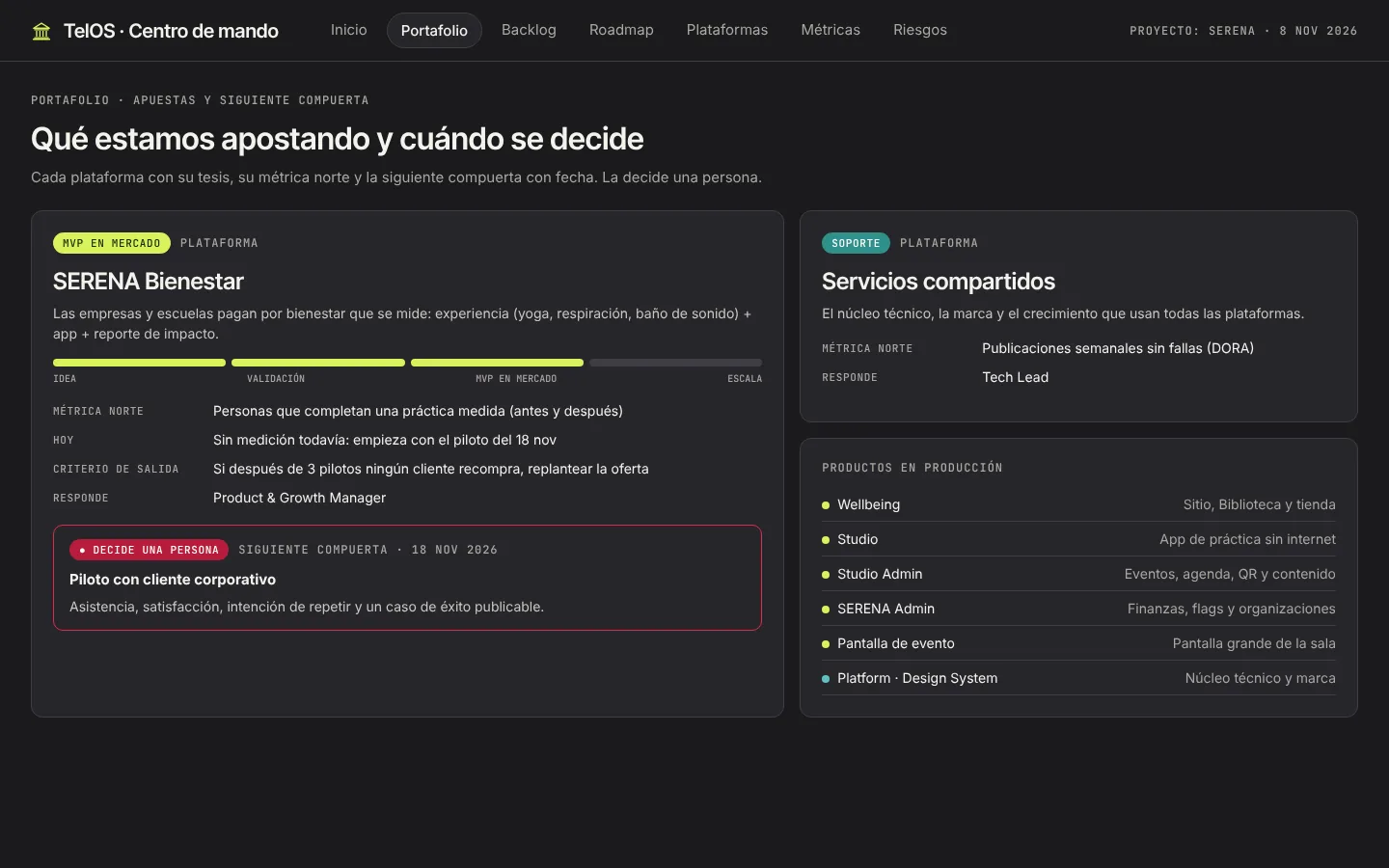
Portfolio
Platforms, products and each one's next gate, with a date. Man in the loop
Factory board
Requirements per train: ready, in progress, in review, shipped. Max 3 in progress.
DORA metrics
Computed from the repo and the log, with the method written down.
Lessons book
Every release leaves a micro-retro; every failure, a lesson.
Short specs win
One page, with acceptance criteria that are tests. Long AI-generated docs go unread.
Block early, don't review late
Automated gates before main cut change failure more than one more human review at the end.
The person decides less, and better
17 merges per human decision. Autonomy is earned with evidence, not assumed.
Want this cycle in your operation?
We start with a 2-week agentic diagnostic and a Decision Brief with your data.